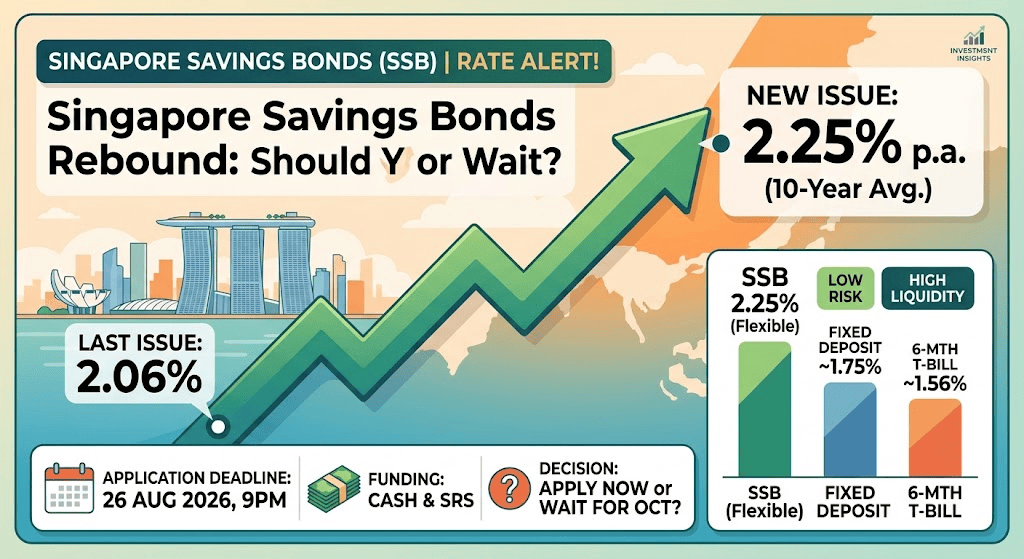
The Singapore Savings Bond (SSB) yield curve has reversed its recent downward trend. The current issuance (SBSEP26 / GX26090V) offers a 10-year average return of 2.25% p.a., up significantly from the 2.06% p.a. offered in the August tranche.
Whether you are looking to park emergency cash or deploy Supplementary Retirement Scheme (SRS) funds safely, here is everything you need to know about this month’s issue and how to position your portfolio.
Key Application Details (SBSEP26)
- 10-Year Average Return: 2.25% p.a.
- First-Year Yield: 1.52% p.a.
- Issue Code: SBSEP26 (GX26090V)
- Application Deadline: Wednesday, 26 August 2026 at 9:00 PM
- Investment Limits: S$500 minimum (in multiples of S$500) up to an individual ceiling of S$200,000
- Funding Sources: Cash or SRS funds
Step-Up Rate Structure
SSBs feature a step-up interest schedule—the longer you hold the bond, the higher the coupon rate you receive each year:
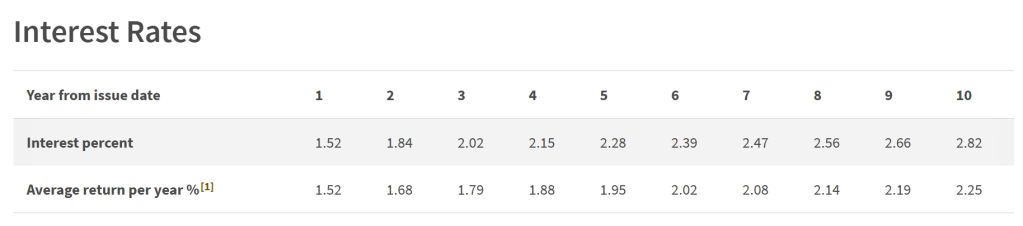
| Holding Period | Yearly Coupon Rate (p.a.) | Average Return (p.a.) |
| Year 1 | 1.52% | 1.52% |
| Year 5 | 2.28% | 1.95% |
| Year 10 (Maturity) | 2.82% | 2.25% |
Market Comparison & Alternatives
While the 10-year average yield has improved, short-term returns lag behind other safe-haven instruments:
- vs. Fixed Deposits: The best 12-month fixed deposit promotional rates sit around 1.75% p.a. (and 6-month promos reach 2.00% p.a.). While this beats the SSB’s Year 1 rate of 1.52%, fixed deposits lock in capital, whereas SSBs allow monthly penalty-free redemptions.
- vs. 6-Month T-Bills: The 6-month T-bill cut-off yield sits at 1.56% p.a.. T-bills offer a slightly higher initial rate for short horizons, but they do not guarantee returns past 6 months.
- vs. 10-Year SGS Bonds: Direct 10-year Singapore Government Securities trade near a 2.36% yield. However, unlike SSBs, selling SGS bonds before maturity subjects you to market price risk.
Outlook: What Expect for the October Issue?
SSB interest rates are fixed using the daily average yields of 10-year SGS bonds from the preceding calendar month.
Because 10-year benchmark yields traded higher throughout August (~2.35% – 2.36%), market models project that the October 2026 SSB issue (opening 1 September) could offer an even higher 10-year average return of ~2.33% p.a.
Should You Buy SBSEP26 or Wait?
- Apply Now (SBSEP26): If you have liquid cash or idle SRS funds earning baseline interest, locking in 2.25% today provides an immediate guaranteed yield floor.
- The “No-Penalty Swap” Strategy: Because SSBs allow monthly redemptions with 100% principal protection and only a S$2 fee, applying for SBSEP26 carries minimal downside. If the October issue opens higher at ~2.33%, you can redeem your SBSEP26 bonds next month and recycle the capital into the October tranche.
How to Apply Step-by-Step
- Log into your DBS/POSB, OCBC, or UOB Internet Banking portal or ATM.
- Navigate to Investments / Fixed Income > Singapore Savings Bonds.
- Enter your CDP Securities Account Number (for cash) or select your SRS Account.
- Submit your application before Wednesday, 26 August 2026, 9:00 PM.
What I Like About SSB?
What I like about SSB is that, unlike stocks, the capital is guaranteed, as well as the interest, for up to 10 years.
While there may be a chance of capital growth for dividend stocks, the capital is not guaranteed, and the stock price can fall drastically in a stock market crash or when something fundamentally wrong happens to the company.
The dividend yield may also increase or drop, depending on the company’s performance.
For SSB, capital and interest are guaranteed as long as you hold them, up to 10 years from the date of purchase.
SSB can be withdrawn any time during the 10 year tenure (within a month’s notice), which makes it an excellent choice as emergency/ contingency funds.

Concluding Thoughts
I am considering putting some of my spare cash into SSB to lock in this rate before it drops again. If it rises, I may redeem this bond to buy the higher interest rate bond in the upcoming months. My SSB portfolio is currently paying me passive income, in the form of interest, every month (SSB laddering) and it is also part of my early retirement plan which I have shared further in this article:
I Am 44 Now, I Plan To Retire When I Reach 55, Here Is My Retirement Plan (With Numbers)
SSB Laddering Strategy explained here:
First Step Towards Rebuilding My Portfolio: Target 200k SSB
*** FOLLOW US ON SOCIAL MEDIA ***
Follow me on Facebook and LinkedIn, to get notified of my latest posts on social media. Or subscribe to my blog (scroll to the bottom of the page) to have my new posts sent directly to your mailbox.
We also have a community passionate about investing, trading, and personal finance over our Telegram or Facebook group. So, join us there for a good discussion, post queries, or simply share your financial knowledge.
*** FREE BEGINNER GUIDE TO OPTIONS TRADING ***
Keen to learn about options trading but do not wish to pay for expensive courses, this newbie guide will help gain the knowledge and fundamentals to understand options better. And it’s totally free!
The Newbie’s Guide To Options Trading
*** SEE MY TRADES & PORTFOLIO ON PATREON ***
If you are interested to find out more about my trades, what shares I am buying/ selling or which options contracts I have opened/ closed, I will be updating them on Patreon (on the same day I made the trades), so do follow me there if you need some reference or inspiration.
Click here to access my Patreon page
*** FREE MOTIVATIONAL BOOK ***
If earning more money from your investment does not excite you anymore, you may be seeking a purpose that brings fulfillment and meaning in life. I have written a motivational book that may be useful to you in some ways.
Click here to download my motivational book
*** BUY ME A CUP OF COFFEE ***
If my blog has benefited you in some ways and you would like to offer a token of appreciation, you may do so via this page. Thank you very much for your support!
Click here to support the site
*** MUST-READ BLOG POSTS ***
The day that I lost everything….
I Was Margin Called, IBKR Liquidated ALL My Positions & Realised S$540k (USD400k) Worth Of Losses
Sharing these 6 fatal mistakes in investing and options trading so you can avoid these pitfalls
The 6 Fatal Investing/ Trading Mistakes That Made Me Lose More Than $1M
After accumulating more than 600k of unrealized losses on my portfolio, I wrote this article to encourage friends and investors who are also losing a lot of money to the market.
If You Are Feeling Depressed From Losing Lots Of Money In The Stock Market, Here’s An Article For You
The precious 6 lessons I learnt after cutting more than half a million of losses in the stock market through bad investments and risky trades.
6 Lessons Learnt After Losing 551k In 10 Years Of Investing & Options Trading | What Newbies Should Know They Start Investing/ Trading
In the 10 years of my investing journey, I have made many mistakes but also learned many lessons from these mistakes. I compiled the 10 most valuable lessons that I have learned and may they help you succeed in your investing journey.
Happy 10 Years Of Investing | 348k (Realised) Profit, 635k (Unrealized) Loss & 10 Lessons Learnt
How I managed to build a 1M investment/ trading portfolio despite coming from humble beginnings.
How A Poor Kid Got To A 1M Investment Portfolio | Tips & Principles Of Building Wealth
I did these 10 side hustles while holding a full-time job, so I share them here so you can be inspired to grow your wealth through a side hustle that you enjoy.
I Did These 10 Side Hustles While Working Full Time | 10 Side Hustle Ideas To Help You Earn An Extra Income
Struggling with inflation and high cost of living? Try these 10 methods to help you save money and accumulate more savings for investments or rainy days.
10 Ways To Save Money To Help You Fight Inflation & Rising Costs Of Living
Why I am building $120,000 of cash reserves in Singapore Savings Bonds (SSB) & 5 reasons why I think SSB is a worthy low or zero-risk investment that you can consider.
Why I Am Building $120,000 Of Cash Reserves In Singapore Savings Bonds (SSB)? | 5 Reasons Why SSB Is A Worthy Low-Risk Investment

