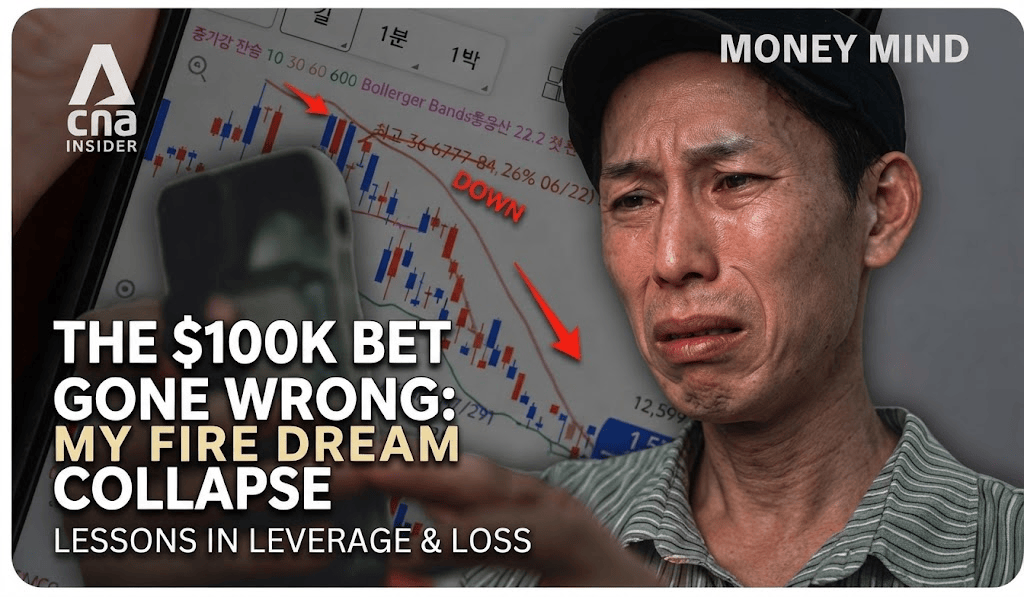
The pursuit of early retirement—popularly known as the FIRE movement (Financial Independence, Retire Early)—has captured the imaginations of workers globally. But in high-cost-of-living nations like South Korea, standard savings strategies often feel entirely inadequate.
For young professionals watching wages stagnate while asset and living costs soar, traditional bank savings accounts can feel like running on a treadmill. Enter high-octane strategies: aggressive leverage, margin trading, and leveraged exchange-traded funds (ETFs).
A recent documentary profile from CNA Insider‘s “Money Mind” explores the journey of Seangun, a South Korean retail investor who leaned heavily into leverage to fast-track his retirement. His story offers a fascinating, cautionary case study on the risks and psychological tolls of accelerated wealth-building.
The Core Dilemma: Why Traditional Saving Falls Short
Seangun’s motivations echo those of a massive generation of retail investors. Earning a standard monthly salary of roughly 3 to 4 million Korean Won, and facing heavy daily living expenses, his maximum realistic monthly savings amount to only about 1 to 2 million Won.
Running the basic math reveals a stark reality: even if every single penny of those savings is put away diligently, reaching a target FIRE nest egg of 300 million Won (approx. $220,000 USD) would take decades—essentially requiring continuous work right up until standard retirement age.
Faced with this timeline, Seangun chose a different path driven by the desire to fast-track his freedom within just a year or two. He abandoned traditional low-yield savings entirely, pouring 100% of his seed capital straight into equity and leverage products.
Understanding the Strategy: How Seangun Used Leverage
Unlike traditional margin loans where an investor borrows cash directly from a broker using portfolio assets as collateral, Seangun utilized built-in product leverage—specifically, US-listed 2x leveraged ETFs.
How 2x Leveraged ETFs Work:
- The Mechanism: These products aim to deliver roughly twice the daily percentage move of the underlying stock or index they track.
- The Upside: If the targeted index rises by 10% in a day, a 2x leveraged product targets a ~20% gain. At one point, Seangun’s aggressive positioning and market tailwinds pushed his investment capital to roughly 230 million Won (about $170,000 USD), combining his personal contributions with strong unrealized gains.
- The Compounding Trap (Daily Reset): Because leveraged ETFs reset their exposure daily, returns compound dynamically. If the market drops 10% one day, the 2x product drops roughly 20%.
- The Safety Distinction: Because Seangun bought these leveraged products directly with his own cash rather than borrowing cash via a direct broker margin loan, he wasn’t immediately vulnerable to a forced broker liquidation or margin call of borrowed money. However, he remained entirely exposed to massive, gut-wrenching drawdowns in portfolio value.
When the Market Reverses: The Brutal Reality of Volatility
The broader macroeconomic environment played a major role in how this played out. A massive AI-fuelled tech rally had driven South Korea’s stock market sharply higher, drawing in legions of retail investors wielding margin loans and leveraged instruments.
Then, the inevitable market cycle reversed. The Kospi fell sharply—dropping 39% in just over five weeks. Across the wider South Korean retail landscape, the damage was catastrophic. By July, an estimated 1.2 million retail investor accounts faced margin calls, forcing investors to either inject fresh capital or face forced liquidations.
Seangun faced his own severe reckoning. Although he didn’t face traditional margin calls, his individual stock-backed leveraged positions suffered tremendous hits. At points, his account reflected staggering losses of 130 million to 140 million Won.
The Shift from Index to Individual Stocks
Reflecting on his journey, Seangun noted a critical pivot that compounded his losses: while he initially started with broader index-based leverage, he eventually transitioned into individual US stock leveraged products—including crypto-related equities. That shift introduced hyper-volatility that tested even his high-risk tolerance.
Psychological Resilience vs. Blind Hope
Despite sitting on six-figure local currency losses, Seangun maintained a surprisingly calm outward composure in his daily life. His thesis rested entirely on a belief in time and mean reversion: “Even though my account is deep in the red, I believe that if I wait, the market will eventually hit the price targets I set.”
He viewed high volatility not as a permanent loss, but as a hurdle that could be endured as long as one survived the swings. However, financial experts warn that psychological endurance is no match for mathematical ruin if the underlying assets do not recover or if the daily compounding decay of leveraged products erodes principal over prolonged sideways markets.
Key Takeaways for Investors
If you are considering leveraging your portfolio to accelerate wealth creation, financial analysts emphasize several critical takeaways from cases like Seangun’s:
- Portfolio-Wide Risk Assessment: Before touching any leveraged product, investors must calculate the absolute worst-case scenario. What does a 30%, 40%, or 50% drawdown do to your mental health and financial solvency? Are you genuinely comfortable with that risk?
- The Danger of Individual Stock Leverage: Index-level leverage (like S&P 500 or Nasdaq 2x products) carries systemic risk, but individual stock leverage exposes you to idiosyncratic corporate blowups that may never recover.
- The Compounding Decay Factor: Leveraged ETFs are designed for short-term trading, not long-term buy-and-hold strategies. Volatility drag can slowly bleed capital even if the underlying index eventually returns to its original price.
- The Balance Between Speed and Survival: Trying to beat the clock to achieve early retirement often introduces risks that can set your financial timeline back by decades rather than advancing it. As Seangun noted when looking back: while he would still use leverage if he could turn back the clock, he would strictly avoid individual stock leverage and stick to broad indexes.
Ultimately, using leverage to chase early retirement is a high-stakes double-edged sword. While it promises a shortcut to financial freedom, it can just as easily turn into a grueling test of survival against the merciless math of market drawdowns.
*** SEE MY TRADES & PORTFOLIO ON PATREON ***
If you are interested to find out more about my trades, what shares I am buying/ selling or which options contracts I have opened/ closed, I will be updating them on Patreon (on the same day I made the trades), so do follow me there if you need some reference or inspiration.
Click here to access my Patreon page
*** FOLLOW US ON SOCIAL MEDIA ***
Follow me on Facebook and LinkedIn, to get notified of my latest posts on social media. Or subscribe to my blog (scroll to the bottom of the page) to have my new posts sent directly to your mailbox.
We also have a community passionate about investing, trading, and personal finance over our Telegram or Facebook group. So, join us there for a good discussion, post queries, or simply share your financial knowledge.
*** FREE BEGINNER GUIDE TO OPTIONS TRADING ***
Keen to learn about options trading but do not wish to pay for expensive courses, this newbie guide will help gain the knowledge and fundamentals to understand options better. And it’s totally free!
The Newbie’s Guide To Options Trading
*** FREE MOTIVATIONAL BOOK ***
If earning more money from your investment does not excite you anymore, you may be seeking a purpose that brings fulfillment and meaning in life. I have written a motivational book that may be useful to you in some ways.
Click here to download my motivational book
*** BUY ME A CUP OF COFFEE ***
If my blog has benefited you in some ways and you would like to offer a token of appreciation, you may do so via this page. Thank you very much for your support!
Click here to support the site
*** MUST-READ BLOG POSTS ***
The day that I lost everything….
I Was Margin Called, IBKR Liquidated ALL My Positions & Realised S$540k (USD400k) Worth Of Losses
Sharing these 6 fatal mistakes in investing and options trading so you can avoid these pitfalls
The 6 Fatal Investing/ Trading Mistakes That Made Me Lose More Than $1M
After accumulating more than 600k of unrealized losses on my portfolio, I wrote this article to encourage friends and investors who are also losing a lot of money to the market.
If You Are Feeling Depressed From Losing Lots Of Money In The Stock Market, Here’s An Article For You
The precious 6 lessons I learnt after cutting more than half a million of losses in the stock market through bad investments and risky trades.
6 Lessons Learnt After Losing 551k In 10 Years Of Investing & Options Trading | What Newbies Should Know They Start Investing/ Trading
In the 10 years of my investing journey, I have made many mistakes but also learned many lessons from these mistakes. I compiled the 10 most valuable lessons that I have learned and may they help you succeed in your investing journey.
Happy 10 Years Of Investing | 348k (Realised) Profit, 635k (Unrealized) Loss & 10 Lessons Learnt
How I managed to build a 1M investment/ trading portfolio despite coming from humble beginnings.
How A Poor Kid Got To A 1M Investment Portfolio | Tips & Principles Of Building Wealth
I did these 10 side hustles while holding a full-time job, so I share them here so you can be inspired to grow your wealth through a side hustle that you enjoy.
I Did These 10 Side Hustles While Working Full Time | 10 Side Hustle Ideas To Help You Earn An Extra Income
Struggling with inflation and high cost of living? Try these 10 methods to help you save money and accumulate more savings for investments or rainy days.
10 Ways To Save Money To Help You Fight Inflation & Rising Costs Of Living
Why I am building $120,000 of cash reserves in Singapore Savings Bonds (SSB) & 5 reasons why I think SSB is a worthy low or zero-risk investment that you can consider.
Why I Am Building $120,000 Of Cash Reserves In Singapore Savings Bonds (SSB)? | 5 Reasons Why SSB Is A Worthy Low-Risk Investment

