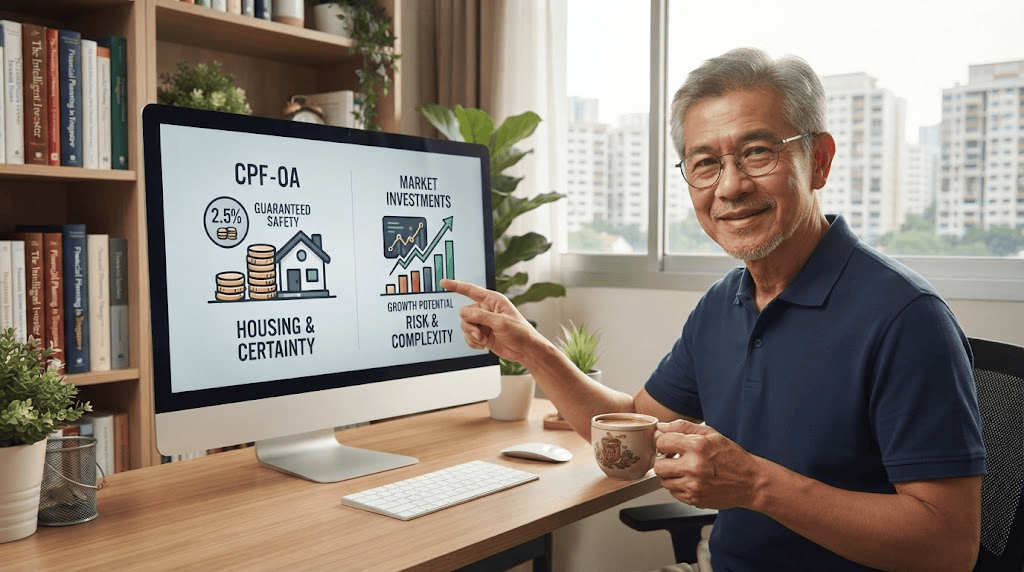
When it comes to personal finance in Singapore, conventional wisdom often pushes investors to maximize returns by deploying every available dollar. For the Ordinary Account (OA) under the Central Provident Fund (CPF), which earns a baseline 2.5% per annum, many assume that leaving funds untouched is an unnecessary opportunity cost compared to what a diversified equity portfolio can achieve over decades.
However, despite managing an active portfolio of stocks, REITs, ETFs, and options, one content creator known as The Dividend Uncle makes a deliberate choice to leave the vast majority of his CPF-OA untouched.
Here is a comprehensive look at why he chooses not to invest his CPF-OA monies, how his family’s circumstances shaped that decision, and why a strategy that works for him might not be right for everyone.
1. Servicing Housing Loans and Managing Single-Income Pressures
The primary driver behind leaving his CPF-OA alone in earlier years wasn’t about beating the stock market—it was about securing household stability. Because his wife is not working, the household has historically depended primarily on a single employment income.
Rather than chasing higher yields through the CPF Investment Scheme (CPFIS), he utilized his CPF-OA to service the monthly housing mortgage and steadily chip away at his family’s biggest liability. While financial theory suggests that keeping a low-interest mortgage while investing cash in equities could yield a higher net worth on paper, maximizing raw net worth wasn’t his sole objective.
Removing a major recurring monthly expense provided immense peace of mind. After roughly 15 years, the mortgage was fully paid off, completely insulating the household from rising interest rates, refinancing stress, and floating-rate volatility.
2. Prioritizing Stability and High-Quality Fixed Income Alternatives
Once the mortgage was cleared, the question naturally shifted: Why not invest the remaining OA money then?
While broad equities are expected to outperform 2.5% over a 20- to 30-year horizon, he argues that equities are not a fair comparison for CPF-OA if the primary objective of that money is safety and capital preservation. Backed by the Singapore government, the OA’s 2.5% floor rate behaves more like high-quality fixed income or Singapore Government Securities.
He wasn’t entirely opposed to improving yields when low-risk opportunities arose—notably participating enthusiastically in Singapore Treasury bill (T-bill) auctions when yields spiked above the OA rate. However, moving funds into T-bills still meant keeping money safely within government-backed credit rather than subjecting it to the sharp market volatility of equities.
3. Factoring in Age, Timeline, and Existing Portfolio Risk
As he approaches age 50, the opportunity cost calculation looks fundamentally different than it did in his 20s or 30s:
- The Long Runway Factor: For a young investor with 30-plus years until retirement, compounding at 2.5% versus capturing higher long-term equity returns represents a massive gap, and there is plenty of time to recover from market downturns.
- Sequence-of-Returns Risk: As retirement draws closer, a sharp market correction right after leaving the workforce poses a severe threat—especially if one is forced to liquidate assets while prices are depressed.
- Already Wealth-Generating Elsewhere: Because he already maintains substantial exposure to equities, REITs, global ETFs, and dividend stocks outside of CPF, he sees no requirement for his CPF-OA to mimic that exact same risk-on behavior. Keeping the OA stable balances his overall net worth.
4. Planning for Spouse Retirement and CPF LIFE
Looking forward to age 55, he also views his CPF-OA as a strategic tool to support his wife’s retirement. Because her CPF balances are lower due to not working, he intends to use excess OA savings (subject to prevailing rules and limits) to top up her Retirement Account. This helps build a stronger, more resilient monthly payout for her under CPF LIFE from age 65.
Why This Approach Might Not Make Sense for You
While this philosophy provides incredible peace of mind for a single-income household nearing mid-life, the creator readily admits that his strategy may be entirely wrong for other investors:
- Your Age: If you are much younger with decades ahead of you, the long-term compounding cost of leaving money at 2.5% is significantly higher.
- Your External Portfolio: If most of your total wealth sits inside CPF with little to no exposure to external growth assets, keeping your OA uninvested leaves your overall financial position overly conservative.
- Your Life Goals and Housing Needs: If you have no housing loans to service, no dependent family members requiring immediate financial protection, and no planned use for your OA, seeking long-term growth through approved investment vehicles or upcoming initiatives (such as the CPF Board’s planned lifecycle investment schemes slated for 2028) may be a far better fit.
The Bottom Line
Retirement planning is not just about accumulating the biggest possible number on a screen; it is about building household resilience and reducing monthly pressure. For some, that means maximizing every single percentage point of growth through active investing. For others—like The Dividend Uncle—it means trading a degree of potential upside for absolute capital certainty, housing security, and peace of mind.
Watch the full breakdown and discussion here: Why I Don’t Invest My CPF-OA — But It May Not Make Sense for You!
*** SEE MY TRADES & PORTFOLIO ON PATREON ***
If you are interested to find out more about my trades, what shares I am buying/ selling or which options contracts I have opened/ closed, I will be updating them on Patreon (on the same day I made the trades), so do follow me there if you need some reference or inspiration.
Click here to access my Patreon page
*** FOLLOW US ON SOCIAL MEDIA ***
Follow me on Facebook and LinkedIn, to get notified of my latest posts on social media. Or subscribe to my blog (scroll to the bottom of the page) to have my new posts sent directly to your mailbox.
We also have a community passionate about investing, trading, and personal finance over our Telegram or Facebook group. So, join us there for a good discussion, post queries, or simply share your financial knowledge.
*** FREE BEGINNER GUIDE TO OPTIONS TRADING ***
Keen to learn about options trading but do not wish to pay for expensive courses, this newbie guide will help gain the knowledge and fundamentals to understand options better. And it’s totally free!
The Newbie’s Guide To Options Trading
*** FREE MOTIVATIONAL BOOK ***
If earning more money from your investment does not excite you anymore, you may be seeking a purpose that brings fulfillment and meaning in life. I have written a motivational book that may be useful to you in some ways.
Click here to download my motivational book
*** BUY ME A CUP OF COFFEE ***
If my blog has benefited you in some ways and you would like to offer a token of appreciation, you may do so via this page. Thank you very much for your support!
Click here to support the site
*** MUST-READ BLOG POSTS ***
The day that I lost everything….
I Was Margin Called, IBKR Liquidated ALL My Positions & Realised S$540k (USD400k) Worth Of Losses
Sharing these 6 fatal mistakes in investing and options trading so you can avoid these pitfalls
The 6 Fatal Investing/ Trading Mistakes That Made Me Lose More Than $1M
After accumulating more than 600k of unrealized losses on my portfolio, I wrote this article to encourage friends and investors who are also losing a lot of money to the market.
If You Are Feeling Depressed From Losing Lots Of Money In The Stock Market, Here’s An Article For You
The precious 6 lessons I learnt after cutting more than half a million of losses in the stock market through bad investments and risky trades.
6 Lessons Learnt After Losing 551k In 10 Years Of Investing & Options Trading | What Newbies Should Know They Start Investing/ Trading
In the 10 years of my investing journey, I have made many mistakes but also learned many lessons from these mistakes. I compiled the 10 most valuable lessons that I have learned and may they help you succeed in your investing journey.
Happy 10 Years Of Investing | 348k (Realised) Profit, 635k (Unrealized) Loss & 10 Lessons Learnt
How I managed to build a 1M investment/ trading portfolio despite coming from humble beginnings.
How A Poor Kid Got To A 1M Investment Portfolio | Tips & Principles Of Building Wealth
I did these 10 side hustles while holding a full-time job, so I share them here so you can be inspired to grow your wealth through a side hustle that you enjoy.
I Did These 10 Side Hustles While Working Full Time | 10 Side Hustle Ideas To Help You Earn An Extra Income
Struggling with inflation and high cost of living? Try these 10 methods to help you save money and accumulate more savings for investments or rainy days.
10 Ways To Save Money To Help You Fight Inflation & Rising Costs Of Living
Why I am building $120,000 of cash reserves in Singapore Savings Bonds (SSB) & 5 reasons why I think SSB is a worthy low or zero-risk investment that you can consider.
Why I Am Building $120,000 Of Cash Reserves In Singapore Savings Bonds (SSB)? | 5 Reasons Why SSB Is A Worthy Low-Risk Investment

