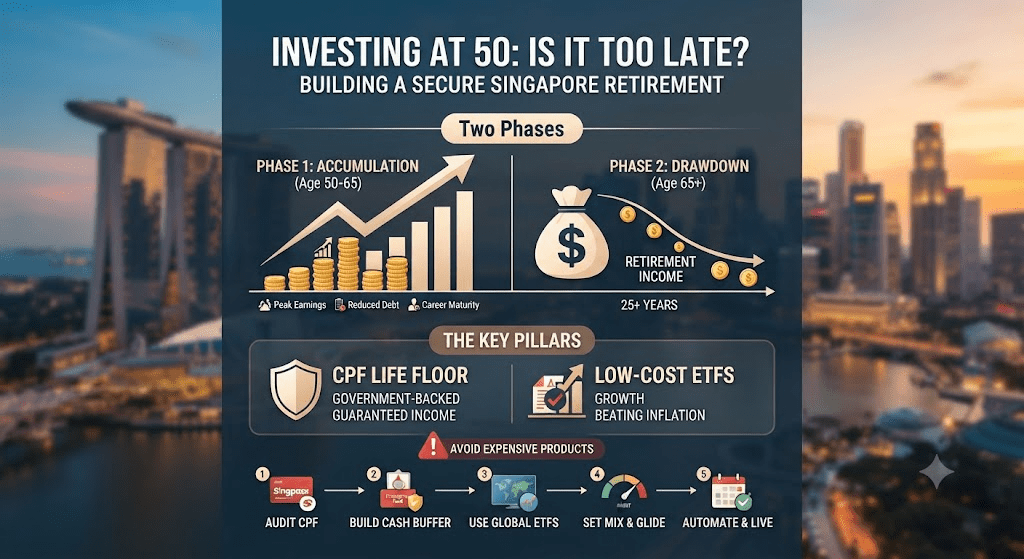
When people wonder whether it is too late to begin building a portfolio at age 50, the underlying anxiety usually stems from a specific assumption: believing that a narrow 15-year window until traditional retirement is simply not enough time for compounding to work its magic.
That concern is understandable on the surface, but it relies on a flawed timeline. Investment horizons do not abruptly slam shut the moment someone turns 65. Nobody cashes out their entire net worth on a single birthday and exhausts it all within months. Instead, capital needs to sustain a drawdown phase that easily spans 20 to 30 years or more. A dollar deployed into the markets at 50 might not actually be spent until its owner reaches 75 or 80, giving it a legitimate 25- to 30-year runway.
Financial life during this chapter naturally divides into two distinct stages:
- The Accumulation Years (Ages 50–65): Often representing peak earning years as mortgages shrink or disappear and dependents become independent.
- The Drawdown Years (Ages 65 and Beyond): A period where a substantial portion of wealth remains invested and continues compounding while modest amounts are systematically withdrawn.
The underlying arithmetic clearly shows that starting at 50 is entirely viable, though the overall strategy requires a different mindset compared to beginning at age 25.
The Numbers: What Can You Realistically Grow?
Evaluating projections through a conservative lens—such as an average annual return of 6% to account for pre-retirement caution—illustrates what disciplined habits can achieve:
- The Systematic Contribution Approach: Committing to a disciplined monthly outlay of $1,000 from age 50 to 65 accumulates a total out-of-pocket principal of $180,000. At a 6% growth rate, that balance transforms into roughly $290,000 by age 65. If contributions stop entirely at that point and the balance is simply left untouched to compound for another decade, that pot swells to just over half a million dollars by age 75.
- The Lump-Sum Deployment Approach: For individuals holding accumulated savings in low-yielding deposit accounts, deploying a baseline sum of $100,000 into a balanced, responsible growth vehicle yields approximately $240,000 by age 65 and over $430,000 by age 75.
Using conservative benchmarks, invested capital historically doubles roughly every decade to twelve years, meaning a 50-year-old still has multiple doublings ahead.
What Makes Investing at 50 Different?
1. Sequence of Returns Risk
A young investor weathering a severe market downturn has decades to absorb and recover from the blow. Conversely, when a portfolio reaches its peak size right on the doorstep of retirement, a sharp market correction can inflict major damage at the worst possible moment.
- The Remedy: Avoid going entirely heavy on aggressive equities. Gradually construct a defensive cushion consisting of bonds alongside a dedicated cash buffer—ideally covering several years of living expenses—so that a temporary market downturn never forces a premature liquidation of assets.
2. Recognizing the National Safety Floor
In Singapore, pre-retirees possess a distinct structural advantage through the Central Provident Fund framework. Milestone transitions at age 55 securely channel savings up to the Full Retirement Sum into a dedicated Retirement Account, yielding reliable government-backed returns.
- The Remedy: Treat this national framework as an unshakeable bedrock for basic, everyday survival expenses. Because foundational needs are locked in securely, private investment portfolios outside of this system are liberated from being overly defensive; instead, they can focus entirely on long-term growth and beating inflation.
Three Dangerous Pitfalls to Avoid
- Retreating Entirely Into Cash: Leaving all spare capital in basic savings accounts or fixed deposits out of a desire for safety. While this shields against market volatility, it surrenders ground to a much quieter and more destructive force: inflation. Over a multi-decade retirement, cash slowly loses substantial purchasing power.
- Falling Prey to Hard-Sell Financial Products: Crossing mid-life milestones often draws aggressive marketing pitches for complex insurance-wrapped retirement plans, endowments, or investment-linked policies laden with heavy annual management fees. Over time, those hidden costs siphon away massive portions of potential gains. A good rule of thumb: if a financial product cannot be explained simply in terms of its purpose and exact costs, it has no place in a portfolio.
- Chasing Risky High-Return Gambles: Feeling pressured by a perceived late start sometimes drives individuals toward speculative assets, high-leverage trades, or unverified stock tips in search of overnight windfalls. Taking severe losses on speculative bets at this stage of life can permanently derail retirement security, as the math required to recover from a 50% loss demands a 100% gain just to break even.
A Practical 5-Step Blueprint
- Audit Your Foundation: Check your CPF statements to understand your exact baseline numbers, projected sums, and anticipated monthly payouts. Knowing your guaranteed floor is essential before planning anything else.
- Establish a Cash Safety Net: Set aside an adequate emergency reserve in high-yield instruments to ensure that unexpected life disruptions or poor market years never compromise your long-term holdings.
- Embrace Simplicity Through Broad Funds: Direct discretionary savings into low-cost, globally diversified index instruments rather than attempting to manage an unwieldy collection of disparate products.
- Determine and Glide Your Asset Mix: Adopt an initial equity-to-defense ratio that fits your personal comfort level—keeping in mind that your national savings already serve a heavily defensive role—and progressively tilt more conservative as your target milestone approaches.
- Automate and Step Back: Set up automated monthly transfers from your income stream to your brokerage account, tune out daily market commentary, and limit portfolio reviews to a healthy once or twice a year.
Starting at 50 is far from a lost cause. By steering clear of expensive products, respecting downside risks, and letting low-cost growth vehicles do the heavy lifting alongside a robust national safety net, building a secure financial future remains entirely within reach.
*** SEE MY TRADES & PORTFOLIO ON PATREON ***
If you are interested to find out more about my trades, what shares I am buying/ selling or which options contracts I have opened/ closed, I will be updating them on Patreon (on the same day I made the trades), so do follow me there if you need some reference or inspiration.
Click here to access my Patreon page
*** FOLLOW US ON SOCIAL MEDIA ***
Follow me on Facebook and LinkedIn, to get notified of my latest posts on social media. Or subscribe to my blog (scroll to the bottom of the page) to have my new posts sent directly to your mailbox.
We also have a community passionate about investing, trading, and personal finance over our Telegram or Facebook group. So, join us there for a good discussion, post queries, or simply share your financial knowledge.
*** FREE BEGINNER GUIDE TO OPTIONS TRADING ***
Keen to learn about options trading but do not wish to pay for expensive courses, this newbie guide will help gain the knowledge and fundamentals to understand options better. And it’s totally free!
The Newbie’s Guide To Options Trading
*** FREE MOTIVATIONAL BOOK ***
If earning more money from your investment does not excite you anymore, you may be seeking a purpose that brings fulfillment and meaning in life. I have written a motivational book that may be useful to you in some ways.
Click here to download my motivational book
*** BUY ME A CUP OF COFFEE ***
If my blog has benefited you in some ways and you would like to offer a token of appreciation, you may do so via this page. Thank you very much for your support!
Click here to support the site
*** MUST-READ BLOG POSTS ***
The day that I lost everything….
I Was Margin Called, IBKR Liquidated ALL My Positions & Realised S$540k (USD400k) Worth Of Losses
Sharing these 6 fatal mistakes in investing and options trading so you can avoid these pitfalls
The 6 Fatal Investing/ Trading Mistakes That Made Me Lose More Than $1M
After accumulating more than 600k of unrealized losses on my portfolio, I wrote this article to encourage friends and investors who are also losing a lot of money to the market.
If You Are Feeling Depressed From Losing Lots Of Money In The Stock Market, Here’s An Article For You
The precious 6 lessons I learnt after cutting more than half a million of losses in the stock market through bad investments and risky trades.
6 Lessons Learnt After Losing 551k In 10 Years Of Investing & Options Trading | What Newbies Should Know They Start Investing/ Trading
In the 10 years of my investing journey, I have made many mistakes but also learned many lessons from these mistakes. I compiled the 10 most valuable lessons that I have learned and may they help you succeed in your investing journey.
Happy 10 Years Of Investing | 348k (Realised) Profit, 635k (Unrealized) Loss & 10 Lessons Learnt
How I managed to build a 1M investment/ trading portfolio despite coming from humble beginnings.
How A Poor Kid Got To A 1M Investment Portfolio | Tips & Principles Of Building Wealth
I did these 10 side hustles while holding a full-time job, so I share them here so you can be inspired to grow your wealth through a side hustle that you enjoy.
I Did These 10 Side Hustles While Working Full Time | 10 Side Hustle Ideas To Help You Earn An Extra Income
Struggling with inflation and high cost of living? Try these 10 methods to help you save money and accumulate more savings for investments or rainy days.
10 Ways To Save Money To Help You Fight Inflation & Rising Costs Of Living
Why I am building $120,000 of cash reserves in Singapore Savings Bonds (SSB) & 5 reasons why I think SSB is a worthy low or zero-risk investment that you can consider.
Why I Am Building $120,000 Of Cash Reserves In Singapore Savings Bonds (SSB)? | 5 Reasons Why SSB Is A Worthy Low-Risk Investment

