
The AI hype train is moving faster than ever, and for everyday investors, it’s causing a massive amount of anxiety. Everyone knows AI is the future, but chasing the hottest, most crowded meme stocks often feels like gambling. Is the trend you are buying into today a genuine long-term structural shift, or just a narrative that will evaporate next month?
To find the truth, you have to stop looking at the flashy software demos and start looking at where the physical infrastructure is breaking. Specifically, you need to look at two signals:
- What Google is telling software developers about where applications will actually run.
- What Nvidia is ordering from its supply chain to build its next-generation supercomputers.
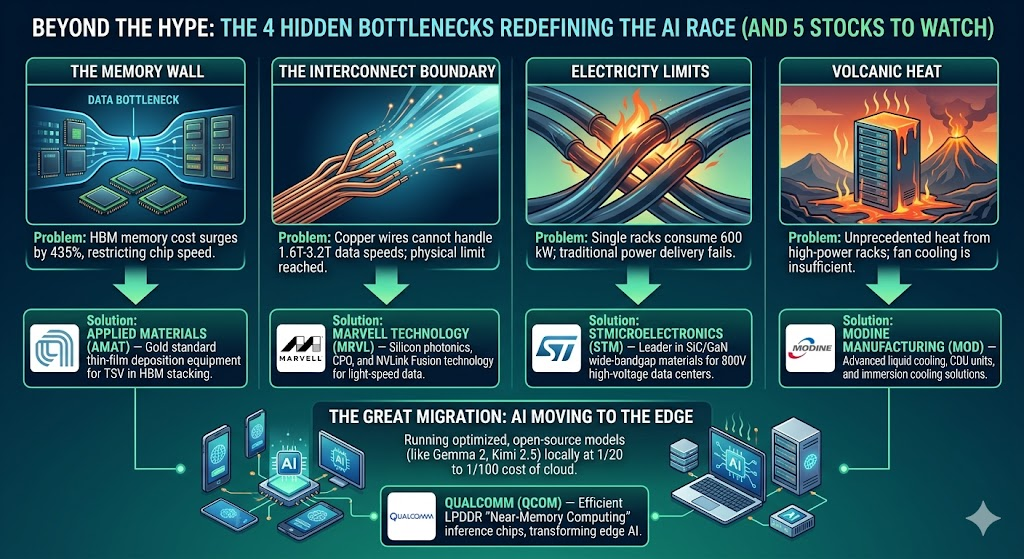
When you look closely at these two giants, a clear picture emerges: AI is hitting hard physical limits in memory, interconnectivity, power, and cooling.
Here is a breakdown of how the AI landscape is shifting, the bottlenecks threatening to slow it down, and five under-the-radar companies positioned to profit by solving them.
1. The Great Migration: AI is Moving to the Edge
For the past few years, the standard playbook for any enterprise wanting to use AI was simple: connect to an API from OpenAI, Anthropic, or Google, and pay by the token. This model made cloud giants filthy rich, but for businesses, it has become unsustainably expensive and a nightmare for data privacy.
Recently, massive industry leaks revealed that engineering teams at tech giants like Uber had completely burned through an entire year’s worth of cloud AI token budgets by April alone.
But a shift is happening. At its latest developer conference, Google quietly laid the groundwork for a revolution by making its Gemma 2 and Gemini Nano models capable of running natively on local corporate servers and consumer smartphones.
Running highly optimized, open-source models locally isn’t a futuristic concept—it’s happening right now. Silicon Valley’s favorite new coding tool, Cursor (via its Composer 2.5 feature), runs on an open-source model developed by Beijing’s Moonshot AI. It matches the performance of elite closed-source models at one-twentieth of the cost. Similarly, Airbnb’s massive customer service infrastructure relies heavily on Alibaba’s open-source Qwen model because it is “faster, better, and cheaper.”
Over the long term, deploying open-source models locally costs 1/20th to 1/100th of calling a closed-source cloud API. The future of enterprise AI isn’t in the cloud; it’s on the edge.
2. Inside Nvidia’s Rubin Architecture: The 4 Physical Bottlenecks
While software moves to the edge, the data centers trained to build these massive models are facing severe physical constraints.
A recent Macquarie breakdown of Nvidia’s next-generation NVL Rubin server rack revealed a stunning statistic: the cost per rack is skyrocketing from $4 million in the previous generation to a staggering $7.8 million. When you look at the Bill of Materials (BOM), the money isn’t just going to faster compute—it’s going toward fighting the laws of physics.
Bottleneck #1: The Memory Wall
In the Rubin architecture, memory costs have exploded by 435%, jumping from $370,000 to $2 million per rack. Memory alone now consumes more than a quarter of the entire hardware budget. AI chips are processing data faster than memory architectures can feed it to them.
Bottleneck #2: The Interconnect Boundary
The cost of NVLink Switch chips and networking components has surged by over 120%. Why? Because traditional copper wiring can no longer handle data speeds of 1.6T to 3.2T over distances longer than a few millimeters. The data bandwidth between chips has hit its absolute physical limit, forcing the industry to pivot toward Co-Packaged Optics (CPO)—sending data via light rather than electricity.
Bottleneck #3 & #4: Electricity and Volcanic Heat
Nvidia’s latest single server racks consume a jaw-dropping 600 kW of power.
- The Cooling Problem: Trying to cool a 600 kW rack with traditional fans is mathematically impossible—it’s like trying to cool a volcano with a hand fan. Liquid cooling is no longer a luxury option; it is the mandatory default.
- The Power Problem: Delivering that much electricity using traditional 54V systems would require copper cables so thick they wouldn’t fit inside the server chassis, and the electrical resistance would melt the rack. Data centers are being forced to completely overhaul their power infrastructure to 800V high-voltage architectures, a technology borrowed directly from electric vehicle fast-charging systems.
3. The Supply Chain Playbook: 5 Stocks Solving the Bottlenecks
If you want to invest in AI with a margin of safety, you shouldn’t buy the companies generating the hype. You should buy the companies supplying the shovels to fix these bottlenecks. Here are five deeply entrenched, structurally favored companies to watch:
1. Applied Materials (AMAT) — The Memory Wall Play
High-Bandwidth Memory (HBM) isn’t built like traditional computer memory; it requires stacking 12 to 16 layers of memory chips vertically like a skyscraper and connecting them via microscopic holes called Through-Silicon Vias (TSVs). This requires incredibly precise thin-film deposition equipment. AMAT’s machinery is the absolute gold standard for this process. No matter which memory manufacturer wins the HBM war (Samsung, SK Hynix, or Micron), they all must buy their machinery from AMAT to scale up.
2. Qualcomm (QCOM) — The Edge AI Play
Qualcomm is quietly transforming from a smartphone chip company into an AI inference powerhouse. Unlike Nvidia, Qualcomm’s data center inference chips completely bypass expensive, scarce HBM. Instead, they use cheap, power-efficient mobile LPDDR memory coupled with a revolutionary “Near-Memory Computing” architecture. This places the processing units physically closer to the memory, boosting bandwidth tenfold while slashing power. Qualcomm recently secured a massive order from ByteDance for millions of these custom AI chips, with rumors suggesting Amazon’s AWS is next inline. Yet, the market still prices QCOM at a modest smartphone-maker valuation.
3. STMicroelectronics (STM) — The High-Voltage Power Play
To run data centers at 800V, traditional silicon semiconductors literally burn out. They must be replaced with Wide-Bandgap materials like Silicon Carbide (SiC) and Gallium Nitride (GaN). STM is the undisputed global leader in SiC technology, having spent the last few years mastering mass production for Tesla and European EV makers. Now that the technology is mature and manufacturing costs are low, a massive new data center market has landed right in their lap—yet the stock trades at a highly compressed forward P/E in the mid-teens.
4. Modine Manufacturing (MOD) — The Liquid Cooling Play
While industry giant Vertiv gets all the headlines (and trades at a premium valuation of around 70x trailing earnings), Modine offers almost identical liquid cooling exposure at roughly half the valuation. Modine’s CoolZa Coolant Distribution Units (CDUs) are designed directly for Nvidia’s Rubin architecture, and their acquisition of TMG Core gives them a stranglehold on cutting-edge immersion cooling. Their data center revenue grew 531% year-over-year last quarter, and their order book is filled out for the next five years as cloud giants frantically lock down cooling manufacturing capacity.
5. Marvell Technology (MRVL) — The Silicon Photonics Play
When it comes to replacing copper wires with light (CPO), Marvell has quietly assembled an unbeatable portfolio. Over the last few months, they acquired top-tier silicon photonics startup Celestial AI and interconnect specialist XConn. The ultimate validation came when Nvidia directly invested $2 billion into Marvell to co-develop NVLink Fusion silicon photonics technology. Aside from Broadcom, Marvell is the only player in the world that can offer a full-stack solution for optics, switching, and custom AI chip routing—but it trades at a far more attractive price.
The Bottom Line
The next phase of the AI revolution won’t be defined by who builds the smartest chatbot, but by who can successfully deliver the raw power, cooling, memory, and connectivity required to keep these systems alive. By mapping out the physical bottlenecks of the supply chain, smart investors can look past the market noise and position themselves exactly where the capital has no choice but to flow.
*** SEE MY TRADES & PORTFOLIO ON PATREON ***
If you are interested to find out more about my options trades and investment portfolio, I will be updating them on Patreon (on the same day I made the trades), so do follow me there if you need some reference or inspiration.
Click here to access my Patreon page
*** FOLLOW US ON SOCIAL MEDIA ***
Follow me on Facebook and LinkedIn, to get notified of my latest posts on social media. Or subscribe to my blog (scroll to the bottom of the page) to have my new posts sent directly to your mailbox.
We also have a community passionate about investing, trading, and personal finance over our Telegram or Facebook group. So, join us there for a good discussion, post queries, or simply share your financial knowledge.
*** FREE BEGINNER GUIDE TO OPTIONS TRADING ***
Keen to learn about options trading but do not wish to pay for expensive courses, this newbie guide will help gain the knowledge and fundamentals to understand options better. And it’s totally free!
The Newbie’s Guide To Options Trading
*** FREE MOTIVATIONAL BOOK ***
If earning more money from your investment does not excite you anymore, you may be seeking a purpose that brings fulfillment and meaning in life. I have written a motivational book that may be useful to you in some ways.
Click here to download my motivational book
*** BUY ME A CUP OF COFFEE ***
If my blog has benefited you in some ways and you would like to offer a token of appreciation, you may do so via this page. Thank you very much for your support!
Click here to support the site
*** MUST-READ BLOG POSTS ***
The day that I lost everything….
I Was Margin Called, IBKR Liquidated ALL My Positions & Realised S$540k (USD400k) Worth Of Losses
Sharing these 6 fatal mistakes in investing and options trading so you can avoid these pitfalls
The 6 Fatal Investing/ Trading Mistakes That Made Me Lose More Than $1M
After accumulating more than 600k of unrealized losses on my portfolio, I wrote this article to encourage friends and investors who are also losing a lot of money to the market.
If You Are Feeling Depressed From Losing Lots Of Money In The Stock Market, Here’s An Article For You
The precious 6 lessons I learnt after cutting more than half a million of losses in the stock market through bad investments and risky trades.
6 Lessons Learnt After Losing 551k In 10 Years Of Investing & Options Trading | What Newbies Should Know They Start Investing/ Trading
In the 10 years of my investing journey, I have made many mistakes but also learned many lessons from these mistakes. I compiled the 10 most valuable lessons that I have learned and may they help you succeed in your investing journey.
Happy 10 Years Of Investing | 348k (Realised) Profit, 635k (Unrealized) Loss & 10 Lessons Learnt
How I managed to build a 1M investment/ trading portfolio despite coming from humble beginnings.
How A Poor Kid Got To A 1M Investment Portfolio | Tips & Principles Of Building Wealth
I did these 10 side hustles while holding a full-time job, so I share them here so you can be inspired to grow your wealth through a side hustle that you enjoy.
I Did These 10 Side Hustles While Working Full Time | 10 Side Hustle Ideas To Help You Earn An Extra Income
Struggling with inflation and high cost of living? Try these 10 methods to help you save money and accumulate more savings for investments or rainy days.
10 Ways To Save Money To Help You Fight Inflation & Rising Costs Of Living
Why I am building $120,000 of cash reserves in Singapore Savings Bonds (SSB) & 5 reasons why I think SSB is a worthy low or zero-risk investment that you can consider.
Why I Am Building $120,000 Of Cash Reserves In Singapore Savings Bonds (SSB)? | 5 Reasons Why SSB Is A Worthy Low-Risk Investment

