
A massive structural shift is quietly unfolding in the stock market—one that the mainstream financial media is largely ignoring.
Three of the most valuable private companies in modern history are hitting the public markets in a remarkably tight window. However, the real wealth opportunity isn’t inside the hype of these new initial public offerings (IPOs). Instead, it lies in a hidden mechanism of passive index tracking that is about to force a multi-billion-dollar liquidation of the world’s dominant tech companies.
If you understand index mechanics, you can see that a massive “artificial sale” is coming to premium tech stocks. Here is how it works, and how to position yourself for the fallout.
The $4 Trillion Catalyst
We are witnessing an unprecedented wave of massive public listings, all targeting the same exchange within a narrow four-month window:
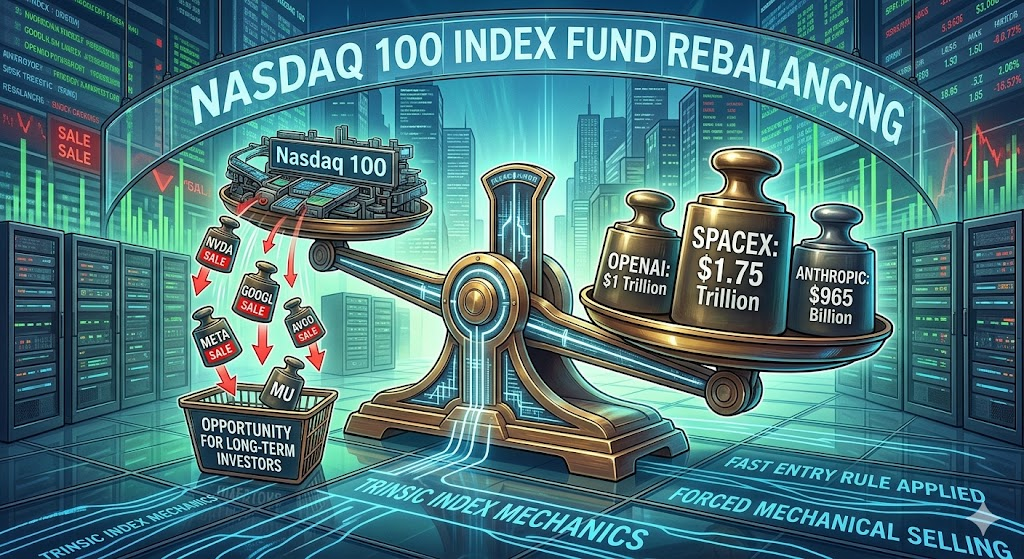
- SpaceX: Valued at $1.75 trillion, its recent Nasdaq debut stands as the largest public listing in stock market history.
- Anthropic: The frontier AI lab behind Claude filed its draft S1 paperwork targeting a valuation of $965 billion.
- OpenAI: Followed suit immediately after, eyeing a public market debut at a valuation cross-cutting $1 trillion.
Combined, these three corporate juggernauts will inject close to $4 trillion in new market cap into the equity ecosystem.
The Fine Print: Nasdaq’s “Fast Entry” Rule Change
Historically, when a massive company went public, index funds couldn’t touch it immediately. The Nasdaq required a “seasoning period” of at least three months. This wait period protected index tracking funds from the extreme volatility, over-subscription, and heavy insider selling that usually follows an IPO launch.
However, effective May 1, 2026, the Nasdaq quietly implemented a major methodology update.
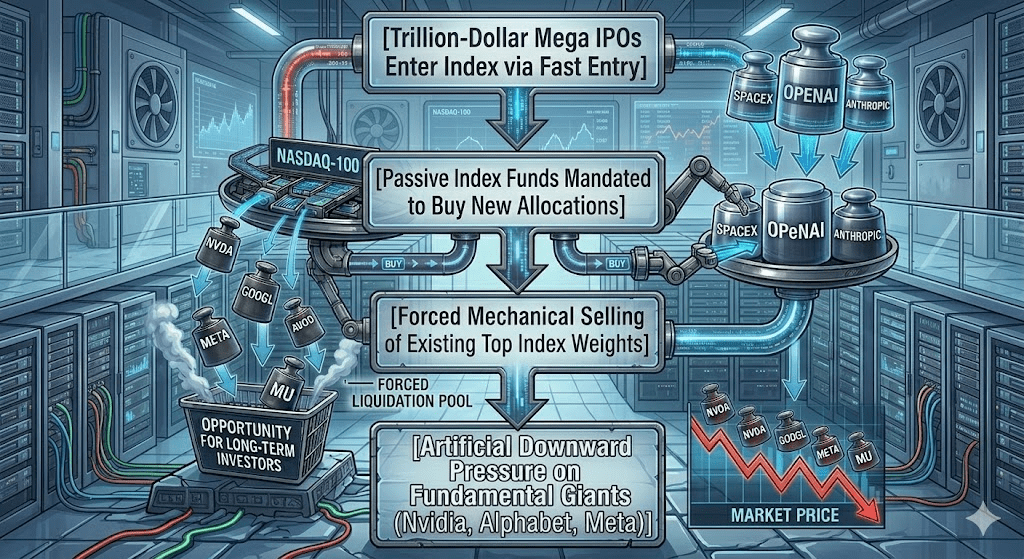
Under the new “Fast Entry” pathway, if a newly listed company’s total market capitalization ranks within the top 40 current constituents of the Nasdaq 100, it can bypass the seasoning period entirely. With a mere five trading days’ notice, it will be fast-tracked into the index after just 15 trading days.
Because SpaceX, OpenAI, and Anthropic easily clear this top-40 threshold, all three are being rapidly absorbed directly into the Nasdaq 100.
The Forced Liquidation Mechanism
To understand why this creates a buying opportunity for existing stocks, you have to look at how passive index funds operate.
The Nasdaq 100 is a market-cap-weighted index. The bigger a company is, the larger its percentage slice of the index pie. Asset managers tracking the index do not make discretionary judgment calls; they follow a mechanical algorithm.
When a multi-trillion-dollar giant like SpaceX or OpenAI enters the index, every fund tracking the Nasdaq 100 must automatically accumulate millions of shares to match the new weight. Because these funds must remain fully invested, they have to sell a fraction of everything else they own to free up the cash.
The larger a company’s existing footprint in the index, the more aggressively it will be mechanically liquidated. The top tech titans currently make up more than half of the total index weight. This means billions of dollars in forced, non-fundamental selling will hit the strongest companies on earth.
The Shopping List: 5 Fundamental Giants Going on Sale
If this forced rebalancing triggers downward pressure on the market’s leading companies, it creates an absolute discount for savvy long-term investors. Five foundational companies stand out as primary targets to accumulate on the dip:
1. Nvidia (NVDA)
As the largest holding in the Nasdaq 100—commanding roughly 13% of the index—Nvidia will face the heaviest volume of forced selling. Yet, its underlying fundamentals remain unmatched. Holding over a 90% share of the data center GPU market, Nvidia recently posted record quarterly revenues of $81.6 billion (up 85% year-over-year). With operating income up nearly 150% and gross margins sitting at a software-like 75%, any forced pullback drops its already modest forward P/E ratio (just over 20) into deep value territory.
2. Alphabet (GOOGL)
When combining its Class A and Class C shares, Alphabet makes up over 11% of the index, rendering it the second-hardest hit by index rebalancing. This creates an excellent entry point for a company processing 3.2 quadrillion AI tokens per month. Google Cloud is growing 63% year-over-year, and unlike its cloud peers, Google designs its own AI processors (TPUs). It is even selling these TPUs directly to index-entrant Anthropic—meaning that even as competitor models gain traction, they have to pay Google to run them.
3. Meta Platforms (META)
Meta has faced slight downward pressure due to its massive $125B+ capital expenditure guidance for AI infrastructure. However, this infrastructure is securing an existential moat: custom inference chips built on TSMC’s cutting-edge 2-nanometer process to serve a massive ecosystem of 3.5 billion daily active users. With ad revenue growing 33% and operating margins at 41%, Meta trades at an incredibly attractive forward P/E of roughly 18. Additional index-driven drops only sweeten the deal.
4. Broadcom (AVGO)
While Nvidia dominates generic enterprise GPUs, Broadcom is the undisputed king of custom application-specific integrated circuits (ASICs). When tech giants like Google, Meta, or OpenAI want to design their own proprietary chips, they rely on Broadcom. This co-design model drove Broadcom’s AI chip revenue up 143% year-over-year last quarter, pacing it toward a massive $100 billion AI run rate next year.
5. Micron (MU)
Whether a data center runs Nvidia GPUs, Google TPUs, or Broadcom ASICs, none of them can function without high-bandwidth memory (HBM). Micron is the pure-play winner of this bottleneck. Last quarter, revenue exploded 196% year-over-year, and gross margins tied Nvidia at 75%. Despite matching the profitability metrics of top-tier chip design firms, Micron trades at an incredibly low forward P/E of just 11, making it the cheapest foundational asset on this list.
The Investor Takeaway
Markets frequently present anomalies where structural plumbing overrides corporate fundamentals. The sudden, fast-tracked entry of $4 trillion in new IPOs is an index-level disruption that mechanical funds must balance at any cost.
When structural index selling pushes the stock prices of hyper-growth giants lower, it isn’t a sign of institutional panic—it’s an automated algorithm cleaning its ledger. For forward-thinking investors, that mechanical necessity is an open invitation to buy the building blocks of the AI revolution at a steep discount.
*** SEE MY TRADES & PORTFOLIO ON PATREON ***
If you are interested to find out more about my options trades and investment portfolio, I will be updating them on Patreon (on the same day I made the trades), so do follow me there if you need some reference or inspiration.
Click here to access my Patreon page
*** FOLLOW US ON SOCIAL MEDIA ***
Follow me on Facebook and LinkedIn, to get notified of my latest posts on social media. Or subscribe to my blog (scroll to the bottom of the page) to have my new posts sent directly to your mailbox.
We also have a community passionate about investing, trading, and personal finance over our Telegram or Facebook group. So, join us there for a good discussion, post queries, or simply share your financial knowledge.
*** FREE BEGINNER GUIDE TO OPTIONS TRADING ***
Keen to learn about options trading but do not wish to pay for expensive courses, this newbie guide will help gain the knowledge and fundamentals to understand options better. And it’s totally free!
The Newbie’s Guide To Options Trading
*** FREE MOTIVATIONAL BOOK ***
If earning more money from your investment does not excite you anymore, you may be seeking a purpose that brings fulfillment and meaning in life. I have written a motivational book that may be useful to you in some ways.
Click here to download my motivational book
*** BUY ME A CUP OF COFFEE ***
If my blog has benefited you in some ways and you would like to offer a token of appreciation, you may do so via this page. Thank you very much for your support!
Click here to support the site
*** MUST-READ BLOG POSTS ***
The day that I lost everything….
I Was Margin Called, IBKR Liquidated ALL My Positions & Realised S$540k (USD400k) Worth Of Losses
Sharing these 6 fatal mistakes in investing and options trading so you can avoid these pitfalls
The 6 Fatal Investing/ Trading Mistakes That Made Me Lose More Than $1M
After accumulating more than 600k of unrealized losses on my portfolio, I wrote this article to encourage friends and investors who are also losing a lot of money to the market.
If You Are Feeling Depressed From Losing Lots Of Money In The Stock Market, Here’s An Article For You
The precious 6 lessons I learnt after cutting more than half a million of losses in the stock market through bad investments and risky trades.
6 Lessons Learnt After Losing 551k In 10 Years Of Investing & Options Trading | What Newbies Should Know They Start Investing/ Trading
In the 10 years of my investing journey, I have made many mistakes but also learned many lessons from these mistakes. I compiled the 10 most valuable lessons that I have learned and may they help you succeed in your investing journey.
Happy 10 Years Of Investing | 348k (Realised) Profit, 635k (Unrealized) Loss & 10 Lessons Learnt
How I managed to build a 1M investment/ trading portfolio despite coming from humble beginnings.
How A Poor Kid Got To A 1M Investment Portfolio | Tips & Principles Of Building Wealth
I did these 10 side hustles while holding a full-time job, so I share them here so you can be inspired to grow your wealth through a side hustle that you enjoy.
I Did These 10 Side Hustles While Working Full Time | 10 Side Hustle Ideas To Help You Earn An Extra Income
Struggling with inflation and high cost of living? Try these 10 methods to help you save money and accumulate more savings for investments or rainy days.
10 Ways To Save Money To Help You Fight Inflation & Rising Costs Of Living
Why I am building $120,000 of cash reserves in Singapore Savings Bonds (SSB) & 5 reasons why I think SSB is a worthy low or zero-risk investment that you can consider.
Why I Am Building $120,000 Of Cash Reserves In Singapore Savings Bonds (SSB)? | 5 Reasons Why SSB Is A Worthy Low-Risk Investment

