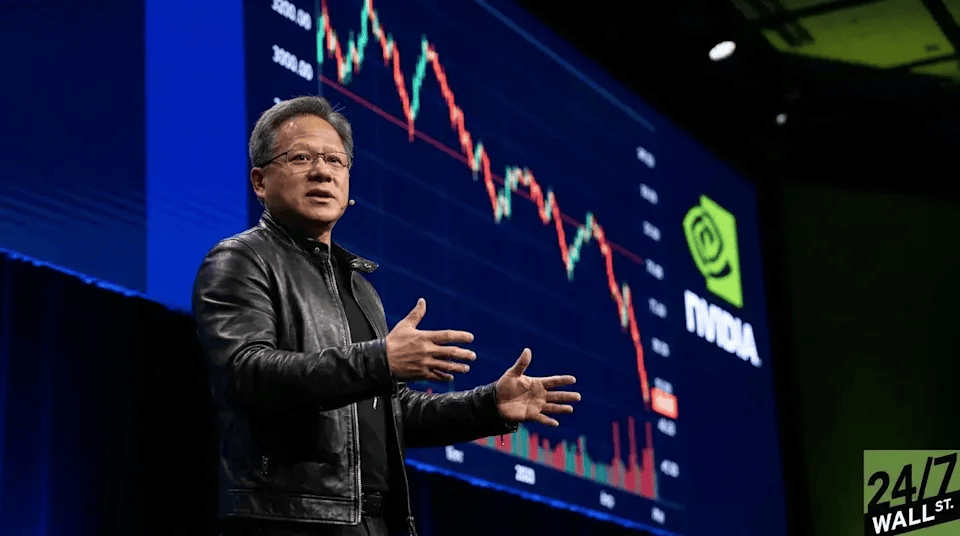
Nvidia (NVDA) has been the undisputed face of the artificial intelligence boom, carrying a near-mythical status on Wall Street. That aura was shattered this week as the stock tumbled into a 27% correction, compressing its valuation to a forward price-to-earnings (P/E) ratio of just 15x—its cheapest multiple since 2012.
The catalyst isn’t a missed earnings report or a sudden drop in chip demand. Instead, it is a corporate governance and national security crisis surrounding founder and CEO Jensen Huang. For long-term investors, the critical question is whether this sell-off is a textbook overreaction to headline noise or a legitimate warning sign of deeper structural risks.
Separating Confirmed Facts from Market Fear
In a November 8 memo to staff, Huang admitted to an extramarital affair, apologizing to his family and employees. Ordinarily, executive personal scandals create brief volatility before fading into the background. However, reports linked the woman involved—Alice Huang, a Chinese executive tied to Singapore-based cloud firm Megaspeed—to allegations of Chinese intelligence recruitment and the illicit diversion of $7.5 billion worth of restricted Nvidia GPUs into China.
Before making portfolio decisions, it helps to separate verified developments from speculation:
- What is confirmed: Nvidia’s board hired outside counsel (Wachtell, Lipton, Rosen & Katz) to conduct an independent investigation, initially stating there was no evidence that proprietary secrets were compromised. Meanwhile, the Department of Justice is pursuing a criminal investigation into Megaspeed, Singapore police are investigating Megaspeed over suspected breaches of domestic laws, and three U.S. House committees have requested a closed-door briefing with Huang.
- What remains unsubstantiated: Neither Huang nor Nvidia has been accused of criminal wrongdoing. The FBI’s involvement is strictly a counterintelligence effort examining whether Huang was targeted by a foreign intelligence operation, rather than an investigation into illegal conduct by the CEO.
The Succession Factor: Why This Case Is Different
Historical data across major tech companies—including Amazon, Microsoft, Google, and Best Buy—shows that executive scandals rarely dictate five- or ten-year stock returns. Over long horizons, share prices track earnings growth and competitive moats.
Yet Nvidia carries a unique vulnerability: key-person risk. Huang has publicly rejected traditional succession planning and reportedly oversees 60 directors who report directly to him. While Jeff Bezos remained at Amazon following his 2019 personal scandal, other tech boards—such as those at Intel, Hewlett-Packard, and Texas Instruments—moved swiftly to replace their CEOs. If board pressure or congressional scrutiny forces Huang to step down, Nvidia lacks an obvious heir apparent, making any leadership transition an immediate operational downgrade.
Valuation vs. Long-Term Fundamentals
On paper, Nvidia looks like a bargain. The company generated $193 billion in earnings over the past year, and trading at 15x forward earnings puts its valuation lower than during the 2020 pandemic crash and the 2022 tech bear market. A discounted cash flow (DCF) model built on consensus analyst estimates—assuming roughly 15% annual earnings growth through 2034 and a 25x terminal multiple—implies an attractive ~18% compound annual growth rate (CAGR) from current levels.
However, valuation multiples only hold up if future earnings materialize as projected. Beyond the headline drama, two fundamental questions challenge Nvidia’s long-term durability:
- Margin Compression: Nvidia currently enjoys near-monopoly profit margins. As tech giants like Google and Amazon scale custom silicon alongside rival offerings from AMD, pricing power will inevitably face downward pressure.
- CapEx Cyclicality: Hyperscalers cannot expand AI capital expenditures indefinitely. When data center buildouts eventually plateau, semiconductor manufacturers remain exposed to historical boom-and-bust cycles.
The Bottom Line for Investors
Markets despise uncertainty, and Nvidia currently faces plenty of it—both in Washington and in its long-term competitive landscape. If Huang weathers the political storm and Nvidia defends its pricing power, today’s 15x multiple will likely look like a generational entry point in hindsight.
For investors who prefer predictable cash flows over binary governance outcomes and semiconductor cyclicality, however, sitting out the volatility—and focusing on durable AI beneficiaries like cloud hyperscalers or power infrastructure providers—remains a prudent strategy.
Disclaimer: This article is for informational purposes only and does not constitute financial or investment advice. Always conduct your own due diligence before making investment decisions.
Risk Assessment: Will Jensen Huang Be Sacked as CEO?
Based on breaking developments as of November 12, 2026, the risk of Jensen Huang being ousted or forced to step down has escalated from a remote tail risk to a high and immediate probability.
While the YouTube video framed his departure as uncertain, subsequent reporting from The Wall Street Journal, Bloomberg, and The New York Times indicates the situation has deteriorated rapidly:
- Active Board Preparations to Oust Him: Nvidia’s board of directors has convened to decide Huang’s future and is reportedly working with an external executive search firm to identify both temporary and permanent replacements, weighing interim leadership candidates such as CFO Colette Kress or co-founder Chris Malachowsky.
- Compounding Governance Violations: Beyond the Megaspeed counterintelligence controversy, The New York Times reported on November 11 that Huang also had an affair with a subordinate—Nvidia’s VP of Healthcare, Kimberly Powell. In modern corporate governance, a CEO engaging in a relationship with a direct or indirect subordinate is a standard “for-cause” termination trigger regardless of business performance, as it creates severe legal and HR liability.
- Investor Lawsuits & Public Misstatements: Shareholders have already filed a class-action lawsuit accusing Nvidia and Huang of securities fraud. The suit alleges that Nvidia’s prior statement to The New York Times describing Huang’s interactions with Alice Huang as routine customer meetings was materially false and misleading given their personal affair.
- National Security & Export License Threat: U.S. lawmakers have called on the Commerce Department to suspend active export licenses for Nvidia AI chips to China and Southeast Asia (including Singapore, Malaysia, Thailand, and Vietnam). If keeping Huang as CEO jeopardizes Nvidia’s regulatory standing in Washington or triggers severe export restrictions, the board’s fiduciary duty shifts decisively toward removing him to protect the company’s license to operate.
The Counterbalance (Why He Might Survive Temporarily): Under Nvidia’s bylaws, the board can remove Huang “with or without cause,” but doing so carries immense operational risk because Nvidia has no formal succession plan and 60 direct reports under Huang.
Additionally, President Donald Trump has publicly expressed support for Huang, calling him “above board” and indicating he wants him to remain on the President’s Council of Advisors on Science and Technology. However, with multiple workplace conduct violations, shareholder litigation, and active board succession talks already underway ahead of next week’s earnings, an exit—whether framed as a mutual resignation or a board ouster—now appears more likely than not.
*** SEE MY TRADES & PORTFOLIO ON PATREON ***
If you are interested to find out more about my trades, what shares I am buying/ selling or which options contracts I have opened/ closed, I will be updating them on Patreon (on the same day I made the trades), so do follow me there if you need some reference or inspiration.
Click here to access my Patreon page
*** FOLLOW US ON SOCIAL MEDIA ***
Follow me on Facebook and LinkedIn, to get notified of my latest posts on social media. Or subscribe to my blog (scroll to the bottom of the page) to have my new posts sent directly to your mailbox.
We also have a community passionate about investing, trading, and personal finance over our Telegram or Facebook group. So, join us there for a good discussion, post queries, or simply share your financial knowledge.
*** FREE BEGINNER GUIDE TO OPTIONS TRADING ***
Keen to learn about options trading but do not wish to pay for expensive courses, this newbie guide will help gain the knowledge and fundamentals to understand options better. And it’s totally free!
The Newbie’s Guide To Options Trading
*** FREE MOTIVATIONAL BOOK ***
If earning more money from your investment does not excite you anymore, you may be seeking a purpose that brings fulfillment and meaning in life. I have written a motivational book that may be useful to you in some ways.
Click here to download my motivational book
*** BUY ME A CUP OF COFFEE ***
If my blog has benefited you in some ways and you would like to offer a token of appreciation, you may do so via this page. Thank you very much for your support!
Click here to support the site
*** MUST-READ BLOG POSTS ***
The day that I lost everything….
I Was Margin Called, IBKR Liquidated ALL My Positions & Realised S$540k (USD400k) Worth Of Losses
Sharing these 6 fatal mistakes in investing and options trading so you can avoid these pitfalls
The 6 Fatal Investing/ Trading Mistakes That Made Me Lose More Than $1M
After accumulating more than 600k of unrealized losses on my portfolio, I wrote this article to encourage friends and investors who are also losing a lot of money to the market.
If You Are Feeling Depressed From Losing Lots Of Money In The Stock Market, Here’s An Article For You
The precious 6 lessons I learnt after cutting more than half a million of losses in the stock market through bad investments and risky trades.
6 Lessons Learnt After Losing 551k In 10 Years Of Investing & Options Trading | What Newbies Should Know They Start Investing/ Trading
In the 10 years of my investing journey, I have made many mistakes but also learned many lessons from these mistakes. I compiled the 10 most valuable lessons that I have learned and may they help you succeed in your investing journey.
Happy 10 Years Of Investing | 348k (Realised) Profit, 635k (Unrealized) Loss & 10 Lessons Learnt
How I managed to build a 1M investment/ trading portfolio despite coming from humble beginnings.
How A Poor Kid Got To A 1M Investment Portfolio | Tips & Principles Of Building Wealth
I did these 10 side hustles while holding a full-time job, so I share them here so you can be inspired to grow your wealth through a side hustle that you enjoy.
I Did These 10 Side Hustles While Working Full Time | 10 Side Hustle Ideas To Help You Earn An Extra Income
Struggling with inflation and high cost of living? Try these 10 methods to help you save money and accumulate more savings for investments or rainy days.
10 Ways To Save Money To Help You Fight Inflation & Rising Costs Of Living
Why I am building $120,000 of cash reserves in Singapore Savings Bonds (SSB) & 5 reasons why I think SSB is a worthy low or zero-risk investment that you can consider.
Why I Am Building $120,000 Of Cash Reserves In Singapore Savings Bonds (SSB)? | 5 Reasons Why SSB Is A Worthy Low-Risk Investment

